If you want to know how to rank in ChatGPT, here is the honest starting point: nobody is going to hand you a rank. What you can do is get your business cited and, more importantly, recommended by ChatGPT, Gemini, and Google's AI answers. That is what I have been working on for my own business for the past few months.
When I first looked into AI SEO, almost everything I found was either a high-level explanation or an example from a giant company with a huge marketing budget. Nobody was showing a small business owner the exact steps. So I figured it out for myself, and now multiple pages from my website are cited in AI search results, and even my YouTube videos show up as sources.
In this post I will walk you through the simple three-part framework I use and the exact Semrush reports I use to apply it. If you would rather watch than read, the full screen-share tutorial is right below.
How to Rank in ChatGPT: The Short Answer
To rank in ChatGPT and other AI search tools, work on three things: the content you publish on your own site, where your business shows up on the platforms AI already trusts (like Reddit, LinkedIn, and YouTube), and how AI perceives your brand. Aim to be cited as a source, but more importantly aim to be recommended. A tool like Semrush can show you the specific prompts, sources, and credibility gaps to work on, so you are not guessing. Like traditional SEO, it takes time and consistency.
Why AI Search Is Such a Big Opportunity for Small Businesses
People do not just Google things anymore. They also ask ChatGPT, Gemini, and other AI tools for recommendations. Even when they do use Google, they are increasingly getting AI-generated answers at the top. When I searched for the best landing page builder for a small business, the first thing I saw was an AI-generated answer recommending tools like Leadpages, Canva, and Unbounce.
What makes those recommendations valuable is how differently people use AI compared to a normal search.
With Google, you traditionally get a list of websites. You click through them, read the information, compare your options, and make the decision yourself.
With AI, people give it a lot more context. Sometimes it is several paragraphs about their situation, their budget, and their specific needs. The AI does the research, pulls from different websites and sources, compares the options, and comes back with a personalized recommendation.
Because the recommendation is tailored to them, people are more likely to trust it and act on it. Think about what that means for you. Someone could be looking for exactly what you sell, and AI could name your company as one of the best options. That is a very qualified potential customer who has already been told you are a good fit.
Cited vs Recommended: The Difference Most People Miss
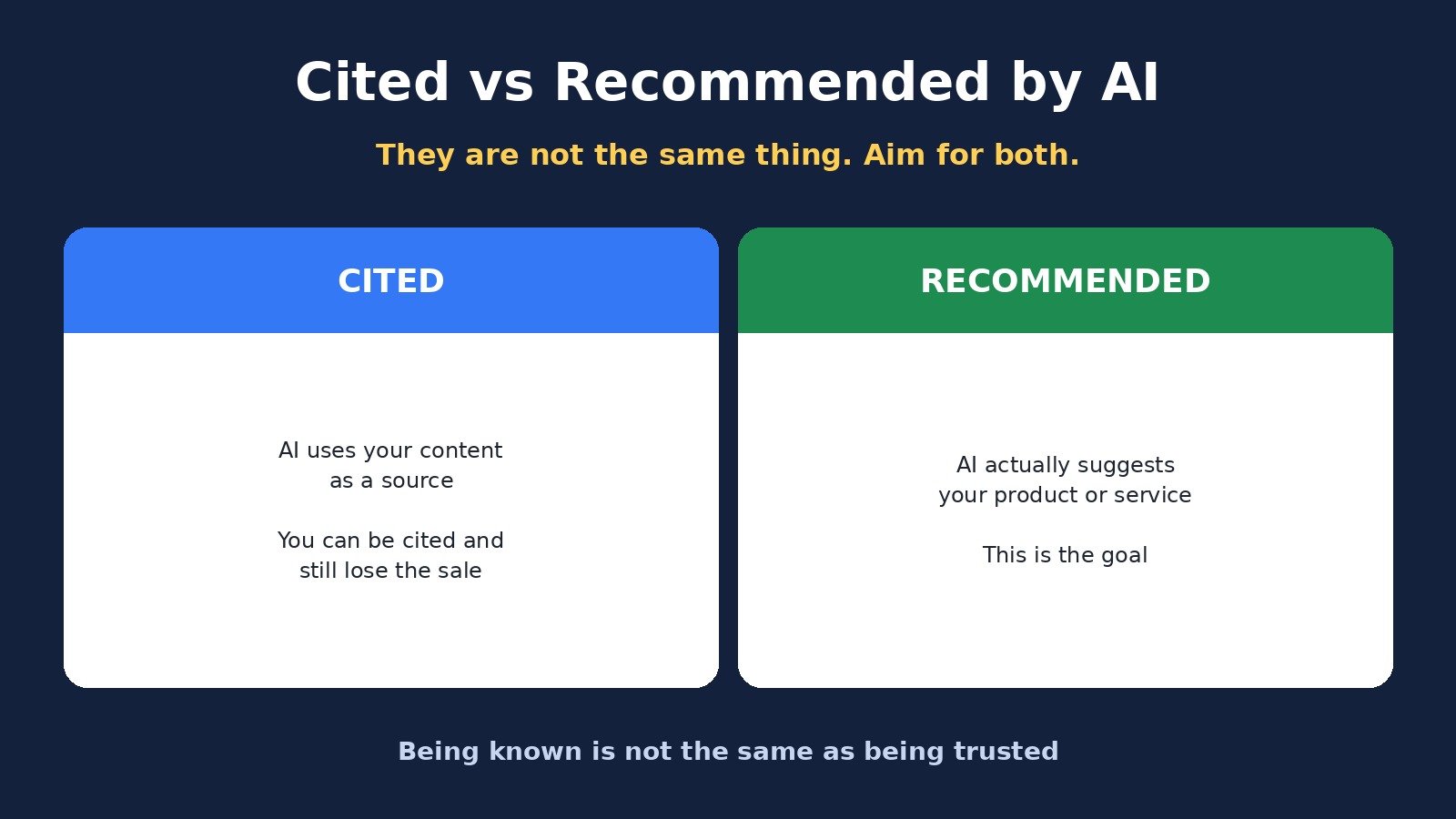
There is one distinction I think most people miss. Just because AI cites your website as a source does not mean it is recommending your business. It could use your content to answer a question and then recommend your competitor instead.
So the goal is both. You want AI to cite your content, but more importantly you want it to actually recommend your business. Being known is not the same as being trusted, and AI seems to weigh both. Later in this post I will show you how I check where I stand on each.
The 3-Part AI SEO Framework I Use
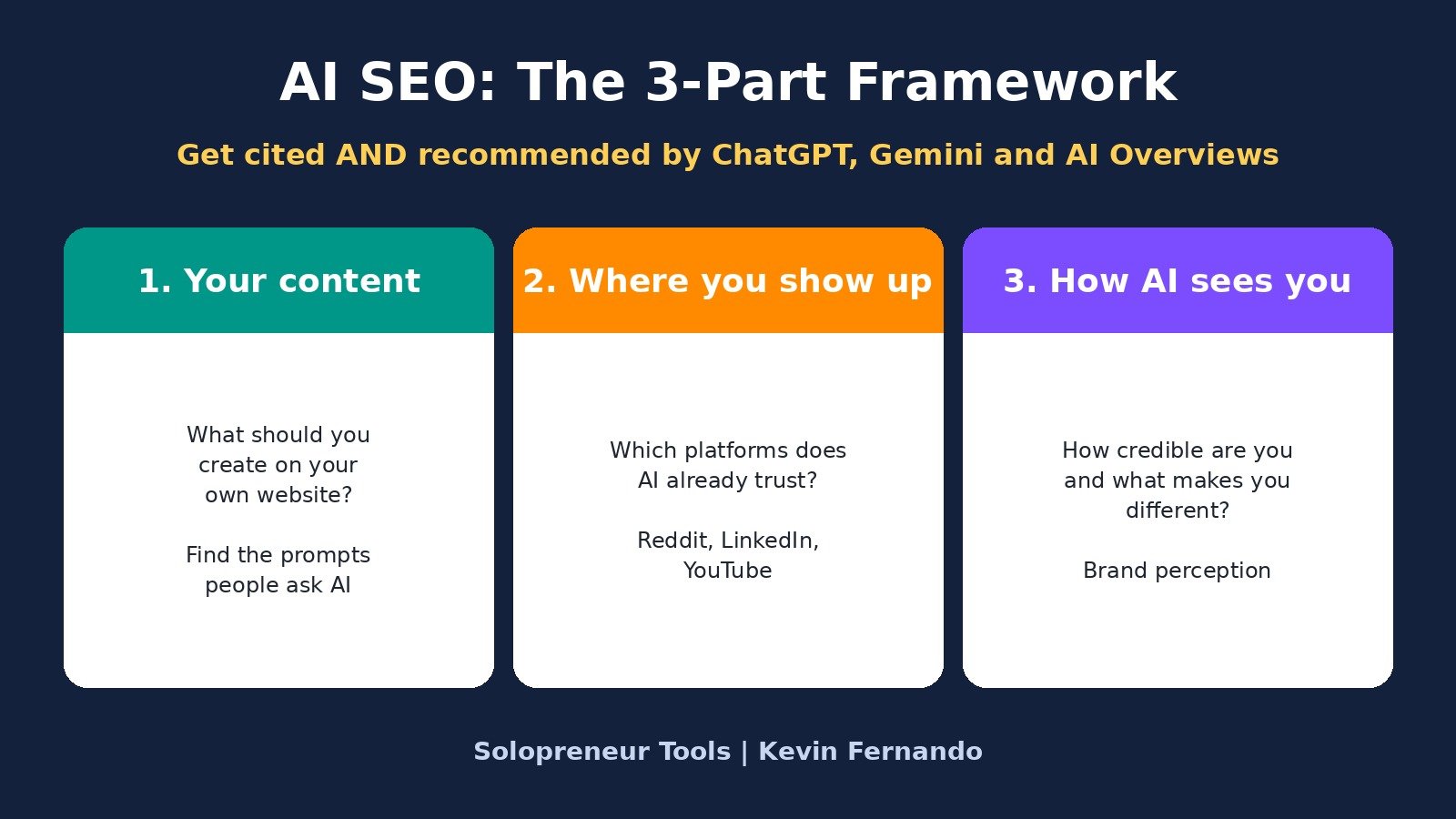
After months of working on this, I boiled it down to three questions that apply to any business in any industry:
What content should you create on your own website? This is where you find the topics and prompts people are actually asking AI about.
Where does your business show up online? Especially on the websites and platforms AI already trusts and uses as sources.
How does AI perceive your brand? How credible you look, and what makes you different from your competitors.
The tool I use to answer all three for my own business is Semrush. It analyzes your business and shows you the content to create, where to show up online, and personalized recommendations for improving how AI sees your brand. Instead of walking away with general advice, you get a plan that is specific to you.
Step 1: Check Your AI Visibility Score in Semrush
The only tool you need for the first part is Semrush. Start the extended 14-day free trial. The trial is for Semrush One, the plan that includes both the SEO tools and the AI SEO tools we need here.
Sign up with your email or Google, which takes a few seconds. On the dashboard, click AI, and in the Visibility Overview, enter your domain.
When I entered mine, my AI visibility score came back as 14 out of 100. You might be wondering if that is low. It is not, really. When I tried a well-known company that makes landing page and email marketing software, with hundreds of millions in annual revenue, it scored just 26. Everyone is early here. If your own site shows zero or a low number, low is not low. Even some of the biggest companies in the world are not at 50.
The overview breaks down what is happening:
Mentions: how many times your brand is mentioned
Citations: how many times your website is cited
Cited pages: how many specific pages of yours are cited
You can also see the mentions split by AI model. When I recorded the video, I had one mention on Gemini, and my cited pages were across Gemini and Google's AI search. That told me there was room to get picked up more by ChatGPT.
Scroll down and you will see your top performing topics, which is where you are already being cited and mentioned. You can organize this by topic or by prompt. Click view full response on any prompt and you can read the actual AI answer, see the sources, and see who else is being sourced. For one of mine, I was both mentioned and a source.
Step 2: Find Content Opportunities From Your Competitors
Knowing where you already show up is useful, but I wanted to find more opportunities. Open Topic Opportunities, add a few of your competitors, and hit analyze. Semrush shows you topics and prompts where those competitors are being cited and you are not.
Two examples from my own account were "how to open a startup business" and "AI tools to generate videos." I did not rank for the first one, which makes it an opportunity. Click into a prompt and you can see who is currently being cited for it.
This is where it gets really practical, because you can study how the winning content is structured. For the video tool prompt, I noticed a few things:
A lot of the cited content was an in-depth list format, a comparison of the top 10 tools.
It was not only articles. The sources were a mix of articles, the software providers' own sites, and YouTube videos.
So my mental note was that a list format seems to work well if you want to be recommended, and video counts as a source too. The action item is to pick the prompts or topics you want to be recommended for, then model your content on the best performing results.
Drafting the content
If you click create content, Semrush gives you the keywords to use and a title. I should be transparent that this is a separate product, their content plan add-on, which you would need to purchase to generate the article inside Semrush.
If you are not ready for that, there is a free workaround I showed in the video. Screenshot the keywords and title, take them into a tool like ChatGPT, and ask it to write the post. Give it a better prompt than "write this blog post," of course. It will use those keywords and get you most of the way there.
I would not just ship AI content as-is. Clean it up and make it personal. But having 80% of the draft done for you is a big time saver. If you end up producing a lot of volume, that is when the paid add-on may start to make sense.
Step 3: Use Prompt Research When You Already Have a Hunch
The topic view is great for discovery. But if you already know or suspect which topics matter to your audience, go to Prompt Research and type them in.
In the video I tried "best small business marketing platforms." The first thing to look at is the intent breakdown. For that topic, 53% of the prompts were informational and 22% were commercial. Commercial means people are using that query to buy, so they are in buying mode. Informational is good too because it brings in people at the top of the funnel. A mix like this is great, and if you want to target only the people most likely to buy, look for terms where the commercial number is as high as possible.
You will also see which sources show up most. For that topic, YouTube, Reddit, and Facebook were the top sources. Hold that thought, because it is the second part of the framework.
Then click into a specific prompt like "marketing tools for small businesses," see who is being sourced, and study what they are doing. It is the same playbook as before. Visibility helps you discover opportunities, and prompt research helps you dig into an opportunity you already suspect is there.
Where AI Gets Its Answers: Reddit, LinkedIn, and YouTube
Creating content on your own site is not the only way to get cited. If certain domains keep showing up as top sources, that tells us AI models trust those domains. A lot of real conversations happen there, and they have become trusted sources.
To give you an example, I looked up a prompt about Repurpose.io reviews, which is a tool I have reviewed. I was being cited on YouTube, not just on my website. So the goal is to think beyond blog posts. Study the sources for each prompt and ask where you are allowed to participate and contribute.
How I find the conversations to join
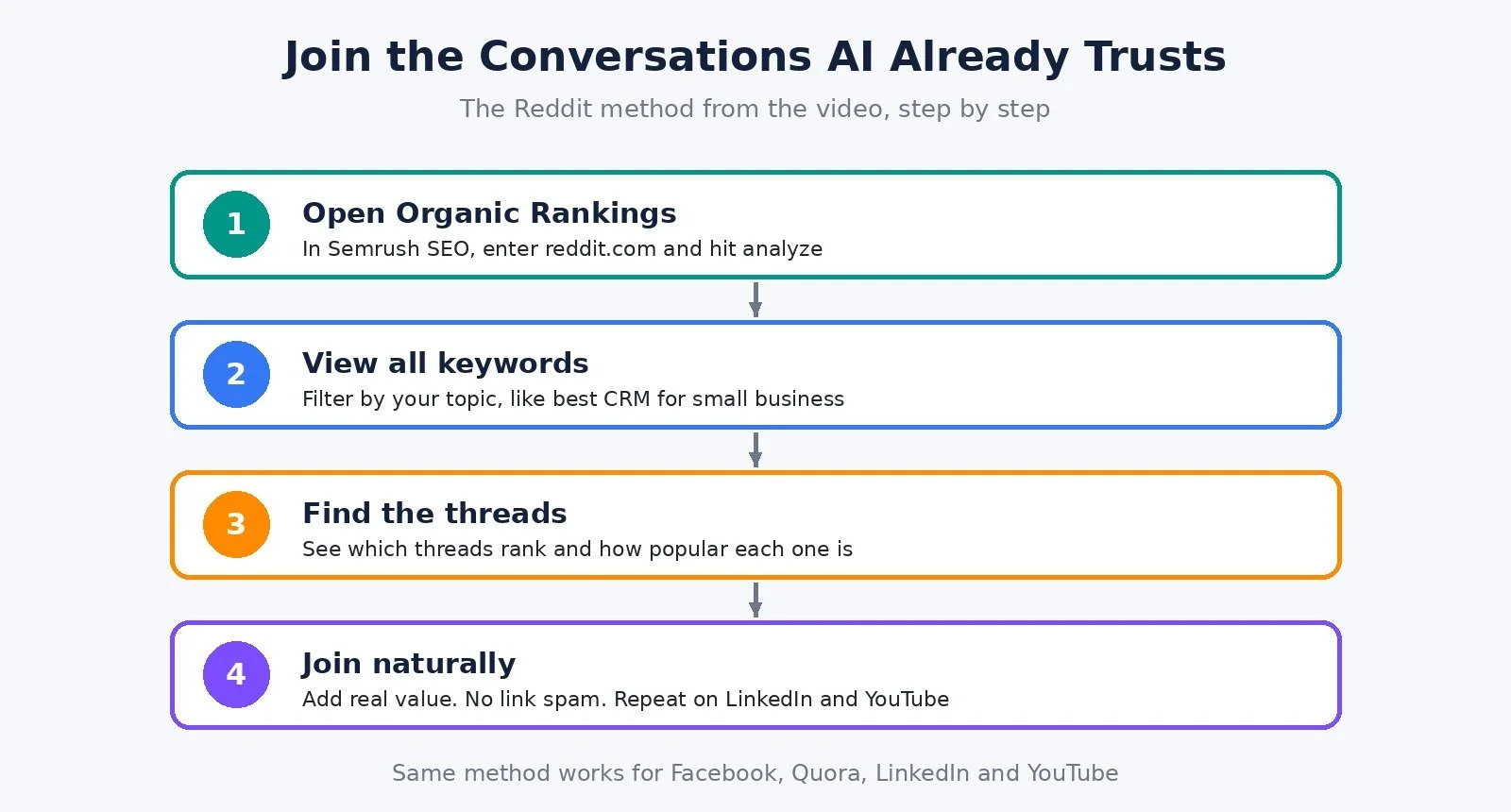
Reddit calls itself the homepage of the internet, so I use it as the example. Here is the trick I showed in the video:
In Semrush, go to SEO, then Organic Rankings.
Type in reddit.com and hit analyze.
Click view all keywords and filter by a topic, such as "best CRM for small business."
You can now see the exact Reddit threads ranking for that query, along with how popular each one is.
Some threads get thousands of views. Pick the ones where your expertise is relevant and join the conversation naturally. Do not spam your links. Be genuinely helpful. The same approach works for LinkedIn, Facebook, Quora, and YouTube. When I tried it with "landing page builder," I could see the LinkedIn posts I could comment on.
You are doing two things at once. People can find you in the places they already are, and AI looks at all of those signals out there to build a picture of you. The more your profile grows, the more likely it is to cite and recommend you.
Step 4: Check How AI Perceives Your Brand
This is the part I have not seen anyone else talk about, and it is the difference between being cited and being recommended. You can be well known and still not be recommended. Semrush has several reports for tracking and quantifying this.
Brand Performance. Enter your website, add a few competitors if you like, and you will see your overall sentiment. Mine was positive. You also get competitive comparisons of how AI sees you versus them. What I found most useful is that it lists strategic opportunities specific to your business, organized by urgency, with the order to tackle them in. One of my recommendations was to shift my brand positioning from a tool directory toward something more specific to how I help solopreneurs. That is the kind of thing I would otherwise pay a consultant to tell me.
Perception. This shows how AI sees you against your competitors by category. You get the areas where you are doing well and the areas for improvement, including things that could make an AI model question your credibility. It also gives recommendations for what to fix.
Narrative Drivers. This is one of my favorites. It shows the topics and narratives your audience cares about, such as which tools solopreneurs lean on to automate marketing tasks. It is a fantastic source of content ideas, and it shows how you stack up on each one.
Questions. This shows the topic distribution of your audience and their intent, such as comparison, education, and tool selection, with more recommendations.
The takeaway is to implement the urgent recommendations first and plan for the medium-term ones. I have used these to rebuild my site with new positioning and implemented a number of the recommendations on the pages I have built for it.
Your AI SEO Action Plan
Here is how I would approach this if you are starting from zero:
Start your Semrush free trial and enter your domain in the AI Visibility Overview to see your starting score.
Use Topic Opportunities and Prompt Research to pick the prompts you want to be recommended for.
Look at who is being cited for each prompt, then model your content on the formats that work.
Find the Reddit, LinkedIn, and YouTube conversations about those topics and add real value.
Work through the Brand Performance, Perception, Narrative Drivers, and Questions reports, starting with the urgent items.
Make it a monthly habit, not a one-time project.
Just like traditional SEO, this will not happen overnight. It takes time, consistency, and work. But I genuinely believe it could be some of the highest ROI marketing work you do. Even companies doing hundreds of millions or billions in revenue are still figuring this out, so we are all early. It reminds me of getting into SEO before everyone realized how valuable it was.
The good news is that most of the work is the same as traditional SEO: creating useful content, building authority, getting mentioned on reputable sites, and improving your website. You are not doubling your workload. You are getting more from the same effort in both Google and AI search.
Who This Is For
A good fit if:
You run a small business or solo business and want to be recommended by AI tools
You already create content, or you are willing to start
You want specific next steps instead of general AI SEO advice
Look at other options if:
You want a guaranteed ranking or fast results. This is long-term work.
You are not ready to spend time on content, community participation, and brand positioning
You mainly want to use Semrush with Claude or ChatGPT for a keyword plan. I cover that in AI SEO With Semrush: Build a Practical 90-Day Plan.
FAQ
How do I rank in ChatGPT?
Work on three things: the content on your own website, your presence on trusted platforms like Reddit, LinkedIn, and YouTube, and how AI perceives your brand. Aim to be both cited as a source and recommended as an option.
What is AI SEO?
AI SEO, sometimes called AI search optimization, is the work of getting your business cited and recommended by AI tools like ChatGPT, Gemini, and Google's AI answers. In my experience, a lot of it overlaps with traditional SEO: useful content, authority, and mentions on reputable sites.
What is the difference between being cited and being recommended by AI?
Being cited means AI uses your content as a source. Being recommended means AI actually suggests your product or service. AI can cite you and still recommend your competitor.
What is a good AI visibility score?
There is no magic number. My score was 14 out of 100, and a much larger company I checked scored 26. If yours is low, that mostly means there is room to grow.
Do I need Semrush to do AI SEO?
No, but it is the tool I use because it shows the prompts, sources, and brand perception data in one place. The AI SEO reports I show are in Semrush One, which you can try free through my link. The content plan add-on is a separate product and is optional.
How long does AI SEO take?
Like traditional SEO, it does not happen overnight. It takes time and consistency, so I recommend making it part of your monthly marketing routine.
What to Do Next
Start the Semrush free trial and check your AI visibility score.
Pick three prompts you want to be recommended for and study who is being cited.
If you make videos, see how I turn them into articles in Turn YouTube Videos into Blog Posts with AI.
Browse Best Tools for the rest of the stack I recommend.
If you want help setting up AI and automation in your business, I take on projects through my services.
If you want an AI employee to take recurring marketing work off your plate, I also tested that in AI Employee for Newsletter Automation: How I Hired Viktor to Run Mine.
Disclosure: Some links in this post are affiliate links. If you purchase through them I may earn a commission at no extra cost to you. The video this post is based on was made in partnership with Semrush.
Make more. Spend less. Work less. Get cited, get recommended, and let AI send you better customers.